Friday, March 10, 2017

Bonzo The Dog

I dug this interesting little figurine in a 1920s-1930s city dumpsite.


Like most figurines, I usually don't do much research on them, but this one seemed special. As you can see, theres an unnatural hole on the top of the body of the dog. I wondered what this was. A candleholder, maybe?

The Research Process
I started by looking up "Vintage dog candleholders". I found pictures like this, so I was getting somewhere.


I remembered the gold luster on the dog, so I added gold luster to my keywords.


Then, I stumbled upon this picture. Both my figurine and this one had a similar hole. This could either have been a pincushion holder, toothpick holder, or planter!


Now that I knew what to search, I started entering keywords like "Lusterware dog pincushion holder". One of the pictures called the dog by the name "Bonzo".


Curious, I searched "Bonzo the dog pincushion holder". I found an eBay store that was selling Bonzo collectibles. That's when I found the match!


 Even the fly on its fail matches up!


I still don't know for sure if it's a pincushion holder, because other listings show similar items listed as planters or toothpick holders.

Who is Bonzo?
Bonzo the dog was created in 1922 by a British cartoonist named George Studdy. Due to Bonzo's popularity amongst children and adults, companies were eager to create Bonzo merchandise that would appeal to the public. Bonzo books, salt and pepper shakers, keychains, and figurines were just some of the merchandise mass produced in the 1920s. Production was not only limited to England, but expanded to other countries such as America and Japan.


Bonzo Collectibles


Thanks for reading!


Monday, March 6, 2017

The TA Snider Preserve Company

I was out digging a while back, and to my surprise I pulled out 3 bottles with original labeling! Even better, it was still legible to an extent! This is an exciting moment for diggers. Below are the 3 bottles. Side note: I would also like to thank my mother for bearing with me as I bring home dirty bottles and refuse to clean them because they are labeled.


Depending on where the bottle was buried, decomposition must have been slowed for some reason. I dug it underneath a metal sign, so I'm guessing the metal protected the bottle's label from decomposing over the years. The decomposition process is very interesting to me, and is something I will definitely look into one day.

The Research/Identification Process
I've been digging 20s-30s dumps for over a year now and I have spent some time studying old glass catalogues, so I would consider myself pretty experienced when it comes to identifying shapes of bottles from this era. I know for sure that this bottle was a ketchup, also known as "catsup", and dates late 20s early 30s. Below is a screenshot of a 1933 Owens-Illinois Bottle Company catalogue depicting a round unembossed ketchup bottle. Note how it was labelled as "Catsup", rather than ketchup.


The hard part about this search was figuring out what company produced this bottle. The base is not embossed, so I didn't have any hints there. I had to rely on what was remaining of the label.

"N, I, D, and E" were visible.

The ingredients were listed here.

Something about preservatives was listed here.
I guessed that the label was advertising how the company omitted preservatives from their ketchup.

I definitely had enough evidence to find the original bottle. Now, all I had to do was search.
I searched different keywords until the search "Nide Catsup antique bottle" resulted in an advertisement for "Sniders Catsup". Below is the advertisement.

I think I had a match! The company was correct, but the labeling of the bottle didn't completely match up. I did some more research and found 2 exact ads.


This bottle was produced by the TA Snider Preserve Company.

The TA Snider Preserve Company
In 1879, 2 men, Thomas A Snider and Robert T Skinner formed a canning business based in Cincinnati, Ohio. According the the book Pure Ketchup, their tomato ketchup recipe was derived from Thomas's wife's tomato recipes, a woman well known for her excellent preserved food.
TA Snider Preserve company was later formed after Skinner and Snider dissolved the canning business. The TA Snider company was known for their use of all natural ingredients. The company often advertised the fact that the brand lacked preservatives to appeal to consumers who were looking for a healthier ketchup. TA Snider also sold canned tomato soup as well as canned beans, relish, and oyster sauce. His products were distributed around the United States and Canada. TA Snider was one of the most popular tomato ketchup brands in the United States.


Other Pictures
An old advertising crate

Vintage advertising postcard

TA Snider Co Canning Jar

Ad for Pork and Beans


That's it on the TA Snider Preserve Company! Thanks for reading! If you know anyone who would be interested in my blog, please send them a link, I'm trying to expand.


Sunday, March 5, 2017

Whistle Soda by Vess Beverages

I dug this shard at a family dumpsite a few months ago.

Art Deco "Whistle" Soda Bottle Shard
This shard belonged to this bottle
I already knew this company from another bottle that I own, but the mystery behind this shard was finding which specific bottle it belonged to. Once I found out, I did some research.
Vess Beverages, a locally owned beverage company (until 1994, when it was sold to Cott Beverages), was located in St. Louis, Missouri and was founded in 1916. Sylvester Jones, nickname "Vess", invented the formula for Whistle, an orange soda, in 1916, the same year that he founded the company. However, the soda was not sold until 1925. During the years of the Great Depression the company suffered from financial troubles, as did many companies during the 1930s. Vess Beverages was purchased by Donald Schneebarger, an advertising genius. He added many other flavors to the line. Below are some advertisements from Vess Beverages for the bottle shard I found.


Thanks for reading!

Estate Sale Find 3/4/17

I went to this estate sale expecting a lot more glass, but to my disappointment there was none left. However, I circled through the house one more time and discovered some etched elegant Depression era glass. I had no idea what the pattern was, but I could tell right away that it was from the late 20s-late 30s. I got it for a great price of 2 dollars!
Here is the piece.


I did some research and I found out that this piece is a cheese and cracker plate.


The pattern is called "Trojan" and was produced by Fostoria Glass Company from 1929-1944.
Trojan was produced in Topaz Yellow (1929-1938), Gold Tint Yellow (1938-1944), and Rose Pink (1928-1935). Yellow is more popular than pink due to the wide range of fancy pieces available. Below are some other pieces of Trojan by Fostoria.


 Fostoria Glass Company of Ohio was founded in 1887. Colored tableware was introduced in 1924. Fostoria Glass served the American table until 1986.


 The etchings were designed by a man by the name of Edgar Bottome. He originally worked for Lenox Glass, but left to work for Fostoria in 1897 as an artist/decorator. He was considered the first of many Fostoria pattern designers.

Thanks for reading!


Thursday, March 2, 2017

Fact of the Day: Twinkies!

I've never been a fan of Twinkies. I remember my grandfather offering them to me when I was little. I  usually refused! However, like most food products, they have an interesting history so I thought I'd do some research to share with my readers.

Twinkies were invented in my home state of Illinois in a town called Schiller Park, during the years of the Great Depression. A man by the name of James Alexander Dewar, who was a baker for the Continental Baking Company, had an idea. As a baker, he realized that strawberry shortcake machines sat unused while strawberries were out of season. He decided to come up with a new fruit filled treat that would appeal to the public. He filled a snack cake with banana creme filling and called it the "Twinkie." The date of invention is April 6, 1930, but they were not introduced until 1933. A package of 2 Twinkies could be purchased for a nickel. They were very popular during the Depression due their cheap price. However, during WWII, the filling was forced to change due to rationing. Banana rationing was heavier in Britain but was also prominent in the United States.

Banana rationing at a market


Due to the banana ration, the original creme filling was replaced with a simple but sweet vanilla creme. Although thought to be only temporary, the new filling proved popular with the public and vanilla has remained the favorite Twinkie filling since the switch. Banana was reintroduced but never regained its original popularity. 

During the 1960s Twinkies were a favorite item to include in bomb shelters because they were believed to last forever.

Twinkies were taken off the market on November 19, 2012, but were reintroduced in 2013.


 2 Twinkie ads

Thanks for reading!


Tuesday, February 28, 2017

An Assortment of 3 Recent Identifications

My second favorite thing besides digging is identifying the items I dig up. For every item I identify, I make a collage to post on my Instagram account. Below are some of the collages and some extra information on recent shards and relics I have discovered the origins of. Enjoy the pictures!


Green Depression Glass Measuring Cup Base   

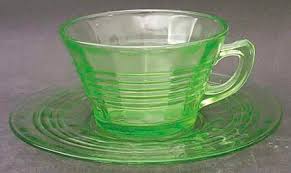
I dug this shard at a 1920s-1930s city dumpsite. I knew that it was a base of something, but I didn't know if it was of a bowl or something else. The remaining glass on the sides came up too straight to be a bowl, so I guessed measuring cup. This was the closest match I could find. Of course, many different variations of green Depression glass measuring cups were produced during the Depression era, so without more evidence it's hard to find a exact match.


Green "Jadeware by Sebring" Bowl

This was a hard one! Based on the visible lettering I guessed the backstamp read "... Ware By ..."
I started by searching different things like "Green Ware 1930s" and other variations. I wasn't having any luck so I started inserting well known pottery companies in the search. I found a match when I searched "Sebring Green Ware". Turns out this piece was a "Jade Ware" bowl by Sebring, made in USA.  Below is a picture of some assorted Sebring Jade Ware.


Clear/Crystal "Circle" Pattern Depression Glass 
Sherbet/Stem Bottom

I identified this piece on accident. I'm not completely sure if this is the piece it belonged to but it's close enough. It's hard to find an exact match when the top part of the stem is not attached. I had dug up another "Circle" pattern shard a while back and while researching, I noticed the base had the same pattern as another shard I was puzzled on.  "Circle" was produced in the 1930s by Hocking Glass in green, pink, and crystal. Below are some other pictures of Hocking's "Circle" pattern.


As always, thanks for reading!